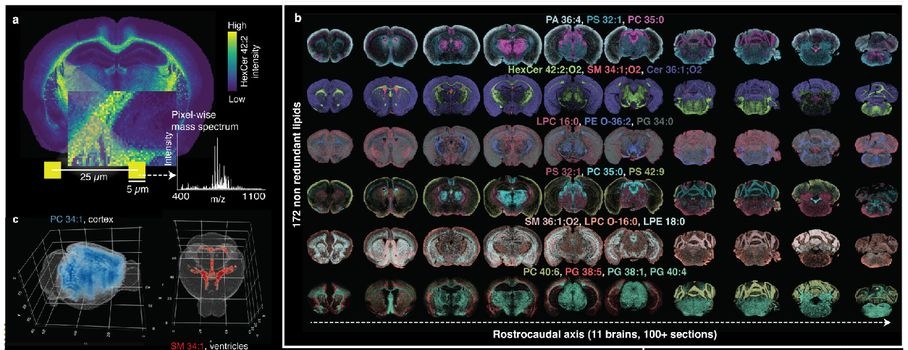
We are excited to announce the release of the Lipid Brain Atlas - a high-resolution mapping of membrane lipids in the mouse brain!
This work, led by Luca Fusar Bassini in collaboration with Giovanni D’Angelo’s lab, reveals that lipids act as zip codes for fine-grained brain anatomy.
Key Discoveries
Lipizones: A New Way to Map the Brain
We discovered lipizones - brain territories defined purely by lipid composition, without any anatomical assumptions. Remarkably, lipid profiles alone can predict 3D brain tissue coordinates with high accuracy.
Oligodendrocyte Heterogeneity
We found striking lipid heterogeneity among oligodendrocytes in the corpus callosum, suggesting that these cells are far more diverse than previously appreciated.
Connecting Cell Bodies to Axon Terminals
Lipid signatures can connect cell bodies to their distant axon terminals, opening new ways to study brain connectivity through biochemistry.
Ventricular System Zonation
We uncovered biochemical zonation patterns in the choroid plexus and ventricular linings, regions critical for cerebrospinal fluid production.
Pregnancy and Sex Differences
Perhaps most surprisingly, pregnancy triggers coordinated membrane adaptations across brain regions. We also found sex differences in white matter sphingolipids that amplify during pregnancy.
Why This Matters
The atlas enables tracking how disease, aging, diet, and medications reshape brain lipid composition at the cellular level. This opens new avenues for understanding: - Cell-type specific metabolism - Developmental history encoded in membranes - Connectivity patterns revealed through lipid fingerprints
Explore the Atlas
The interactive atlas is available at: lbae-v2.epfl.ch
Read the full preprint on bioRxiv.